Cameras & Gear
Game-Changing AI Features in Mirrorless Cameras Today
The jump from film to digital was seismic. The move from DSLR to mirrorless rewrote the camera market. Now, AI is driving the next major disruption — one whe...
The jump from film to digital was seismic. The move from DSLR to mirrorless rewrote the camera market. Now, AI is driving the next major disruption — one where cameras don't just capture scenes, but think, predict, and make decisions in real time. Mirrorless bodies sit at the heart of this transformation, and the features shipping today aren't just marketing bullet points. They genuinely change how you shoot.

AI-Powered Autofocus: Predictive, Not Reactive
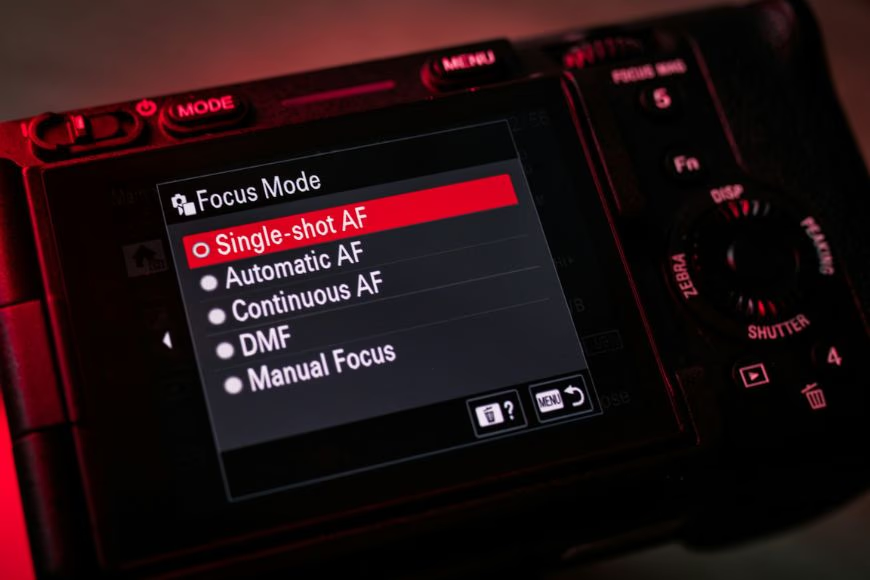
The focus-and-recompose technique might finally be on the way out. Sony, Canon, Nikon, and Panasonic all ship mirrorless bodies with AI autofocus that doesn't just detect a subject — it predicts where it's going. Sony's real-time tracking uses advanced algorithms that transition seamlessly from subjects to specific features like eyes and faces, and keeps lock even when the subject briefly leaves the frame. Canon relies on deep-learning data that distinguishes people from animals with high accuracy. Nikon's system holds focus when a bird ducks behind a branch — the camera understands the subject didn't disappear, it's just occluded.
These aren't incremental AF speed bumps. The camera is calculating where a racing car or flying bird will be milliseconds before it gets there.
Eye and Face Detection You Can Depend On
Modern mirrorless cameras track human faces and eyes with remarkable persistence. When someone turns, blinks, or partially covers their face, the system stays locked. Canon R-series bodies handle this even in poor light. Sony's Real-time Eye AF is now reliable enough that many portrait photographers treat it as the default. Nikon's Z-series can detect eyes through sunglasses.
The practical benefit: you focus on connecting with your subject and let the camera handle the technical lock. Composition gets simpler, and your keeper rate rises.
Subject Detection Beyond Humans
This is where AI subject recognition earns its keep. Cameras from Sony, Canon, Nikon, and Fujifilm now distinguish between people, dogs, cats, birds, motorcycles, cars, trains, and even insects. Sony's high-end bodies offer Insect Eye AF for macro work. Fujifilm's X-H2S identifies birds, motorcycles, and drones as distinct targets. This isn't generic face detection — it's a camera that understands the shape, texture, and motion patterns of what it's tracking, and holds focus with consistency that used to require years of practice.
Scene Recognition That Thinks Ahead
Today's mirrorless cameras analyze a scene and make informed decisions: "backlit portrait at sunset" or "fast-moving sports under fluorescent light." Fujifilm's X-T5 recognizes over 20 distinct scenes and adjusts settings accordingly. Canon optimizes exposure and color dynamically based on scene content. This goes far beyond old-school auto mode — it's contextual awareness that delivers more consistent results in difficult lighting without constant manual adjustment.
Dedicated AI Processors
All of this requires hardware purpose-built for it. Sony now ships a separate AI Processing Unit for visual recognition. Canon bakes AI into the DIGIC platform. These aren't just faster general-purpose chips — they're designed specifically for visual analysis and prediction, running in parallel with the main image processor so the camera stays responsive while analyzing and tracking in real time.
AI-Powered Noise Reduction
Previous-generation in-camera noise reduction was a blunt instrument — it removed noise but often smeared fine texture along with it. AI noise reduction distinguishes between real detail (hair texture, fabric weave) and random sensor noise. Sony's real-time processing preserves fine structure at wildly high ISOs. Canon's system adapts to different noise profiles based on shooting conditions. For anyone working in low light, this means usable frames at ISOs you'd previously have considered off-limits, with natural skin and texture intact.
AI Stabilization Beyond Shake Correction
Image stabilization has evolved from simple shake compensation to predictive systems that anticipate your hand tremor patterns. OM System cameras analyze shake and counter it before it blurs the frame. Sony and Nikon use AI to tell intentional panning from accidental wobble, applying appropriate correction to each. This means you increasingly don't need to turn stabilization off for panning — the camera knows what you're trying to do.
In-Camera Image Enhancement
Some bodies now apply intelligent sharpening, selective contrast, and color enhancement at capture — giving you files that are closer to final the moment you hit the shutter. Canon's latest models recognize skin tones and automatically enhance portraits. Sony offers AI-powered background blur that recreates the bokeh of a fast prime lens. The goal isn't to replace your editing workflow, but to give you a stronger starting point and make quick social-ready exports practical.
Computational Photography and Video
AI-enabled computational photography combines multiple exposures, sensor-shift data, and scene analysis to push past single-exposure limits. OM System cameras produce handheld 50MP files from 20MP sensors using precision hardware and in-body stabilization. Panasonic offers computational ND filters, removing the need for physical glass. Canon and Fujifilm use AI to blend exposures intelligently for HDR that looks natural rather than cartoonish.
On the video side, AI is arguably even more dramatic. Sony's ZV cameras auto-reframe for social formats. Canon's R-series predicts subject movement for smooth focus pulls that previously needed a dedicated focus puller. AI stabilization distinguishes camera movement from hand shake, producing gimbal-like results without the rig.
Practical Tips for Photographers
- Explore your camera's subject-detection modes and map them to a custom button for quick switching between people, animals, and vehicles.
- Don't fight the eye-AF — trust it. Use the mental bandwidth it frees up to work on composition, timing, and subject connection.
- Test your camera's AI noise reduction at high ISOs you'd normally avoid. You may be surprised at what's usable.
- For panning shots, check whether your body's AI stabilization has a dedicated panning mode. Most modern systems detect it automatically.
- Use in-camera enhancements as a preview and a faster social-media export, not as a replacement for full post-processing on paid work.
What Deep Learning Actually Means Inside a Camera
Deep learning is the engine behind most of these features. Manufacturers feed millions of labeled images into neural networks — millions of dogs, faces, cars, birds — until the system learns the visual signatures that make each subject recognizable. When you point your camera at a dog, it's comparing what it sees to every dog it's ever "seen" in training data, matching patterns in real time. That's how it distinguishes an eye from a shirt button, or a bird from a branch it's perched on. The more data these systems consume, the more subjects they recognize.
Final Thoughts
AI features in mirrorless cameras are not a gimmick. They represent a real shift in what a camera can do during the heat of a shoot — track a subject's movement before it happens, hold focus through occlusion, clean up noise without destroying texture, and hand you a file that's closer to finished. Your vision, timing, and composition still drive the frame. AI just gives you the technical headroom to focus on what matters.
FAQ
Does AI autofocus work as well as marketing claims? For most real-world shooting — portraits, weddings, wildlife, sports — it genuinely delivers higher keeper rates. The biggest gap is in very low light or with fast, erratic subjects that lack training data.
Can AI subject tracking follow any animal? Most systems are strongest on dogs, cats, and birds, which dominated their training data. Exotic animals or pets with unusual markings can still confuse the camera, though the coverage is expanding quickly.
Do dedicated AI processors drain the battery faster? They're designed to be efficient, and most photographers report negligible impact. Visual analysis runs in parallel on dedicated silicon, not by taxing the main CPU.
Should I use in-camera AI enhancements or edit manually? Use in-camera enhancements for fast previews and social sharing. For client delivery, manual editing still gives you more control and better results. Think of the AI output as a strong starting point, not the finished image.
Will AI features trickle down to entry-level mirrorless cameras? Yes — the pattern is already clear. Subject detection, improved AF, and basic AI noise reduction are appearing on mid-range and even entry-level bodies from Sony, Canon, and Nikon.